


Rethinking “Big Law” and Building the Goldman Law Team
In mid-2025, having spent 16 years at Blank Rome, Jonathan left to start his own law firm, Goldman Law, PLLC, t/a the Goldman Law Team. After government service, a global pandemic, and other life changes, Jonathan felt like the business of law was changing, too.
Jonathan wanted to do things a little differently, to help clients navigate certain types of problems and achieve their goals through the law in a more bespoke, tailored, and intimate way. For this reason, he created the Goldman Law Team.
Helping Clients Navigate Government Through Goldman Relations
Since leaving government service, clients and potential clients have frequently approached Jonathan and asked for his help on matters that are different from the typical business litigation and other legal representation he has offered clients for years. Given his experience and understanding of how government works, and his many personal and professional relationships throughout all levels of Pennsylvania government, this is not surprising.
These requests have been both narrow and broad. Sometimes they involve questions of policy or law in a certain area, or how to make part of Pennsylvania’s government work better, smarter, or more effectively in an area or issue of particular interest. Sometimes a client just wants to get through to the right person or people in government – someone who can help them with a particular issue or problem of importance – and they need an effective advocate to help explain the problem and suggest a solution in a way that will be heard.
Jonathan often wanted to help. But, as a lawyer working in a law firm, he was limited. Though Jonathan frequently believed he could represent a potential client honestly and effectively, these requests usually went beyond the narrow definition of legal work and did not fit squarely into a traditional law firm model.

Education and Early Career
Growing up outside of Baltimore, Jonathan attended Gilman School, which was one of the most diverse private all-boys schools in the nation. After graduating from high school in 1992, he attended Princeton University.
At Princeton, Jonathan majored in what was then called the Woodrow Wilson School of Public Policy and International Affairs, creating his own focus area: How domestic policy has influenced the development of racial, ethnic, religious, and gender-based groups.
With this, Jonathan picked up a camera during freshman year, minored in visual art, and created a thesis in each.

After graduating in 1996, Jonathan spent his first year post-undergrad teaching English with Princeton-in-Asia and photographing in Kyongju, a small, historic town in South Korea, about six hours southeast of Seoul. There were only about a dozen Caucasians in Kyongju at the time.
Though he did not initially speak, read, or write the language, Jonathan knew how to communicate. Jonathan’s goal during that year, in addition to teaching and making photographs, was to figure out what was next:
Art school or law school?
Jonathan took the LSAT and applied to law school from South Korea. Almost immediately, he knew he had made a mistake –
He wanted to pursue art, not law.
Jonathan withdrew his law school applications and returned to Baltimore without a job. About two weeks after returning home, living at his parents’ house and culture-shocked, Jonathan was recruited out of a shiva house (Jewish house of mourning) to become a Jewish Campus Service Corps Fellow for Hillel at Johns Hopkins University.

Lured, in part, by the promise of being able to use Hopkins’ darkroom to print the photographs he had made at a special school in Kyongju for the mentally and physically challenged, Jonathan became the first full-time Hillel professional on the campus of Johns Hopkins University. In addition to working with students, studying with an Orthodox rabbi, and further exploring his own Judaism, Jonathan served on a strategic study committee to build an independent building for Hillel at Johns Hopkins.
He also applied to art school. In 1998, Jonathan moved to Boston, where he earned an MFA from the School of the Museum of Fine Arts / Tufts University. In addition to photographing, drawing, and painting, wrestling with issues in contemporary art and with his professors, learning to connect and communicate serious and multi-layered issues through visual media, and documenting the diverse residents of his small Section 8 apartment building for his Master’s thesis, Jonathan served as Associate Director of Barbara Singer Fine Art, a nationally known gallery in Cambridge, Massachusetts.
Upon graduation in 2000, Jonathan moved to the City of Philadelphia. He has lived in the City and its suburbs ever since. Jonathan was offered a job as the assistant director of an art gallery, but he turned it down. Instead, he accepted a position as a paralegal at a plaintiff’s employment law firm. There, he spent the majority of his working day on a large class-action age discrimination matter in which a national consulting firm had disproportionately fired older employees during a round of layoffs to make way for others who were younger, more “vital,” and cheaper for the company to employ.
Law School and a Career in “Big Law”

Jonathan matriculated and ultimately graduated from the Beasley School of Law at Temple University in Philadelphia in 2004.
At Temple, he was in the trial advocacy program and served as the Executive Articles and Symposium Editor for the Temple Political & Civil Rights Law Review, which published his article Take That Tobacco Settlement and Super-Size It!: The Deep-Frying of the Fast Food Industry?, 13 Temp. Pol. & Civ. Rts. L. Rev. 113 (2003).
At graduation, he won the Albert H. Friedman Prize for his article Just What the Doctor Ordered? The Doctrine of Deviation, the Case of Dr. Barnes’s Trust and the Future Location of the Barnes Foundation, 39 Real Prop. Prob. & Tr. J. 711 (2005).
After law school, Jonathan clerked for the Honorable Rochelle S. Friedman on the Commonwealth Court of Pennsylvania, a unique, statewide court with both original and appellate jurisdiction that hears appeals from executive branch agencies and legal questions involving state administrative law and government regulation in Pennsylvania.
After a short stint at a midsize firm in South Jersey, Jonathan got a job in Philadelphia as a business litigation associate at the main office of Blank Rome LLP, a national Am Law 100 law firm. There, over the course of decades, Jonathan developed his skills as a seasoned strategist, trial lawyer, and appellate attorney, representing businesses, government, and individuals in commercial disputes, administrative proceedings, and complex litigation in courts across the country. He was active in the Philadelphia Bar Association, served on the firm’s pro bono committee, and was elevated to partner at the firm.

He also advised on and argued key cases for the Commonwealth and the country on topics such as:
Government Service
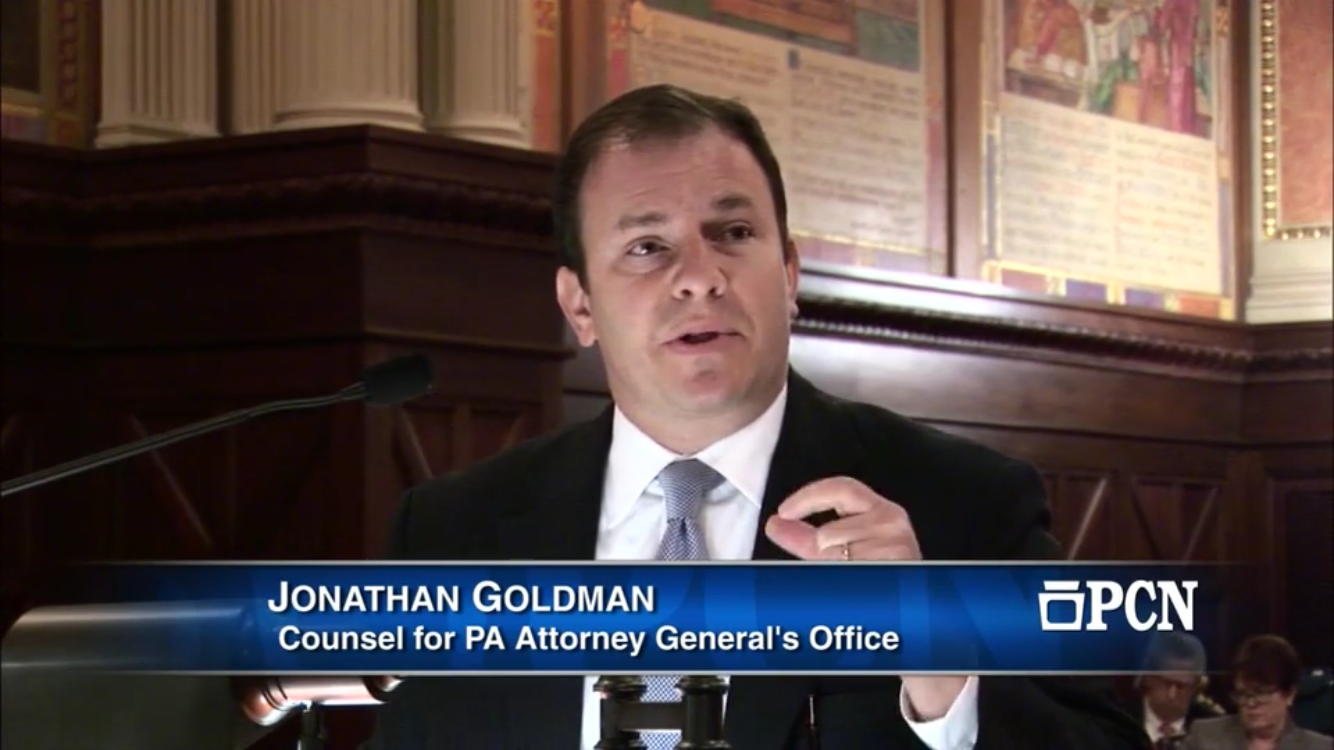
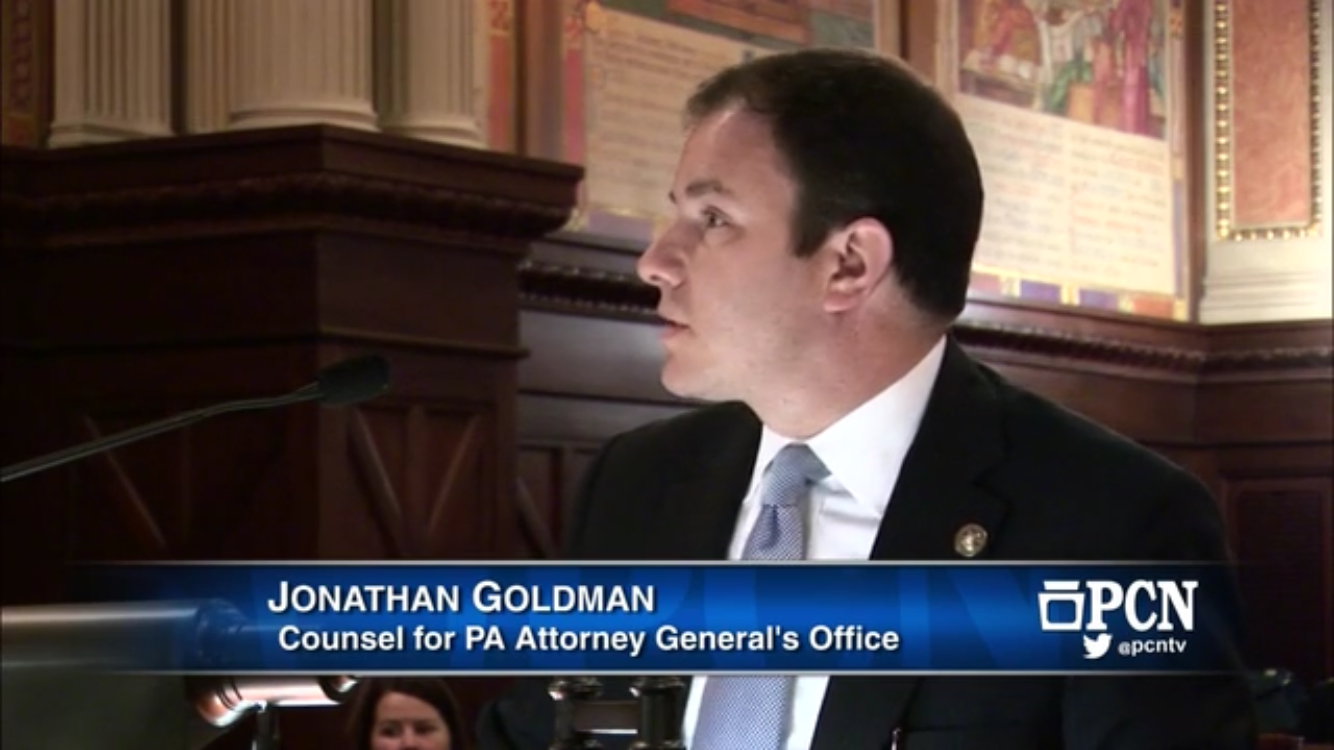
In 2016, when Pennsylvania Governor Josh Shapiro was elected Attorney General, he asked Jonathan to join him at the Office of Attorney General (OAG) in Harrisburg. Jonathan resigned his partnership at Blank Rome and, in January, 2017, was sworn in as an Executive Deputy Attorney General (EDAG) for the Commonwealth of Pennsylvania.
At the OAG, he ran the Civil Law Division, which defends government agencies in litigation across Pennsylvania, and served as a top executive to then-AG Josh Shapiro.
As EDAG, Jonathan oversaw the civil litigation, appellate litigation, tax litigation, torts litigation, bankruptcy, financial enforcement, and legal review sections of the Pennsylvania Office of Attorney General, supervising approximately 130 attorneys, investigators, and other employees in multiple offices across the Commonwealth.
The constitutionality of President Trump’s travel ban
The enforceability of the Affordable Care Act’s contraceptive care mandate
The legal implications of promises made by a nursing home to its residents
The impact of a dispute between behemoth healthcare nonprofits UPMC and Highmark on patients in Western Pennsylvania
The legality of 3D printable guns
The propriety of gerrymandering in Pennsylvania
Life After Government Service
After his government service, Jonathan returned to Blank Rome as a partner in the firm’s business litigation practice group and leaned into his experience with the Commonwealth of Pennsylvania to provide added value to clients.
Among other things, Jonathan created and served as chair of Blank Rome’s national State Attorneys’ General team, attended meetings of the National Association of Attorneys General (NAAG) and Democratic Attorneys General Association (DAGA) across the country, monitored and advised clients on the Commonwealth’s regulations during the COVID-19 pandemic, and served on the board of Blank Rome Government Relations, LLC, the firm’s government affairs, lobbying, and strategic communications business in Washington, D.C.
Over his many years at Blank Rome and in state government, Jonathan saw how smart and thoughtful government relations services – both in addition to and separate from litigation – can be an effective tool to help clients solve problems and achieve their goals. Back at Blank Rome, when a client needed help with a federal agency that was being led by a college classmate and friend, Jonathan registered as a lobbyist, rolled up his sleeves, and got to work. Jonathan understands how government works. Dozens of his friends and former colleagues work at all levels of government throughout Pennsylvania and beyond.
-
Notice of non-legal nature of services pursuant to Pennsylvania Rules of Professional Conduct, Pa. RPC 5.7.
Goldman Relations, LLC is a government relations business entity separate and distinct from any law firm practice with which Jonathan Scott Goldman is affiliated, including Goldman Law, PLLC d/b/a the Goldman Law Team. Though Jonathan is a practicing attorney and a member of the bar of the Commonwealth of Pennsylvania, Goldman Relations does not provide legal services. As principal of Goldman Relations, Jonathan is not acting as your attorney, and neither he nor Goldman Relations are providing you with legal services.
Goldman Relations, LLC maintains strict confidentiality as to all clients and matters. Goldman Relations will not disclose any non-public or proprietary information you have shared with it to third parties without your consent, except as required by law, court order, or as necessary and agreed by you to advocate on your behalf. An engagement with Goldman Relations, however, does not establish an attorney-client relationship, and the legal protections and privileges of an attorney-client relationship do not exist in or apply to any engagement with Goldman Relations. Communications between clients and Goldman Relations are not protected by the legal doctrine of attorney-client privilege.
-
Notice of Compliance with the Pennsylvania Lobbying Disclosure Law, 65 Pa. C.S. § 13A01, et seq.
Goldman Relations, LLC complies with all facets of Pennsylvania’s Lobbying Disclosure Law which, among other things, sets legal registration and reporting requirements and prohibits contingent compensation, conflicts of interest, falsification, and other unlawful acts by lobbyists. While Goldman Relations represents all clients diligently, it makes no promise or representation as to whether the services provided are likely to be successful or lead to the intended result. Goldman Relations does not and cannot guarantee the specific outcome of any matter. Government relations outcomes can be complex and depend on many factors, some of which are beyond its control.